
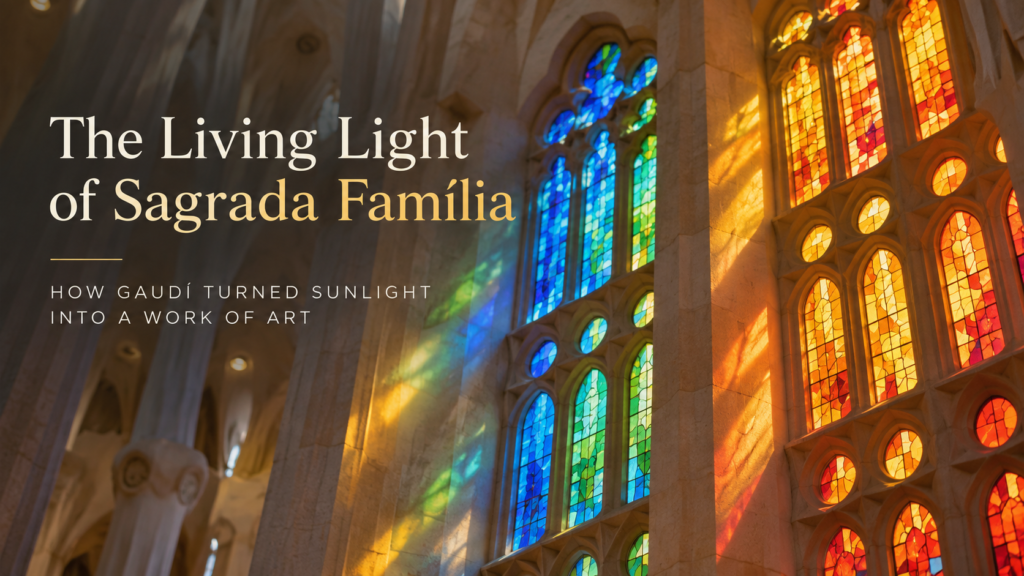
Antoni Gaudí began the Sagrada Família in Barcelona in 1882 and spent the last 43 years of his life on it. He knew he would never see it finished. So he left detailed notes for the parts he could not build himself, and the stained glass windows topped that list. More than a century later, builders are still finishing his design, and the glass now does something few cathedrals ever attempted: it changes color with the hours of the day, on purpose.
The Significance of the Stained Glass Windows
Gaudí treated light as a building material, not an afterthought. He designed the glass to trace the arc of a single day and, by extension, the arc of a life. Cool blues and greens fill the morning side of the basilica. Warm reds and golds fill the evening side. As the sun moves across the sky, the entire interior shifts color with it. Gaudí called color an expression of life, and inside the Sagrada Família, that expression never sits still.
Three Windows That Define the Basilica
1. The Nativity Façade Windows (East Side)
The windows on the eastern, Nativity side greet the morning sun. Gaudí chose blues, greens, and violets here on purpose. He wanted them to echo the calm light of dawn and the quiet joy of Christ’s birth. Morning visitors often say the whole nave feels underwater, cool and still, before the day builds toward something brighter.
2. The Passion Façade Windows (West Side)
On the western, Passion side, the glass turns to reds, oranges, and burning yellows. These colors match the fire of a setting sun, and Gaudí meant them to carry weight. They evoke Christ’s suffering and the fading light of life’s final hours. By late afternoon, this side of the basilica glows like an ember, a deliberate contrast to the cool calm of the Nativity windows across the nave.
3. The Clerestory Windows (Upper Nave)
High above the nave, near the vaulted ceiling, the glass turns almost clear. Gaudí wanted the upper windows to stay light and unobstructed, so the sun could pour straight down and illuminate the mosaic-covered vaults. He put his most saturated, storytelling glass low, near eye level, where visitors could actually read the names and symbols painted into it. He saved the plain white light for the ceiling, and let the sun paint the vault instead.
The Craftsmanship and Design
Gaudí left only sketches and instructions behind. Stained glass artist Joan Vila-Grau spent over a decade turning those notes into finished windows, choosing an abstract style to match Gaudí’s vision without copying older cathedrals. The design team paired the glass with Gaudí’s tree-like stone columns, which branch upward like a forest canopy. Light filters down through colored glass and stone branches together, and the effect turns the entire nave into something closer to a living forest than a traditional church.
A Testament to Faith and Art
Gaudí died in 1926 after being struck by a tram, having seen only a fraction of his design completed. Builders now expect to finish the basilica around 2026, exactly a century later. But the stained glass already delivers what he promised: a building that breathes with the sun and turns an ordinary day into a slow, moving act of worship. Few cathedrals ask visitors to notice the time of day. The Sagrada Família insists on it.