
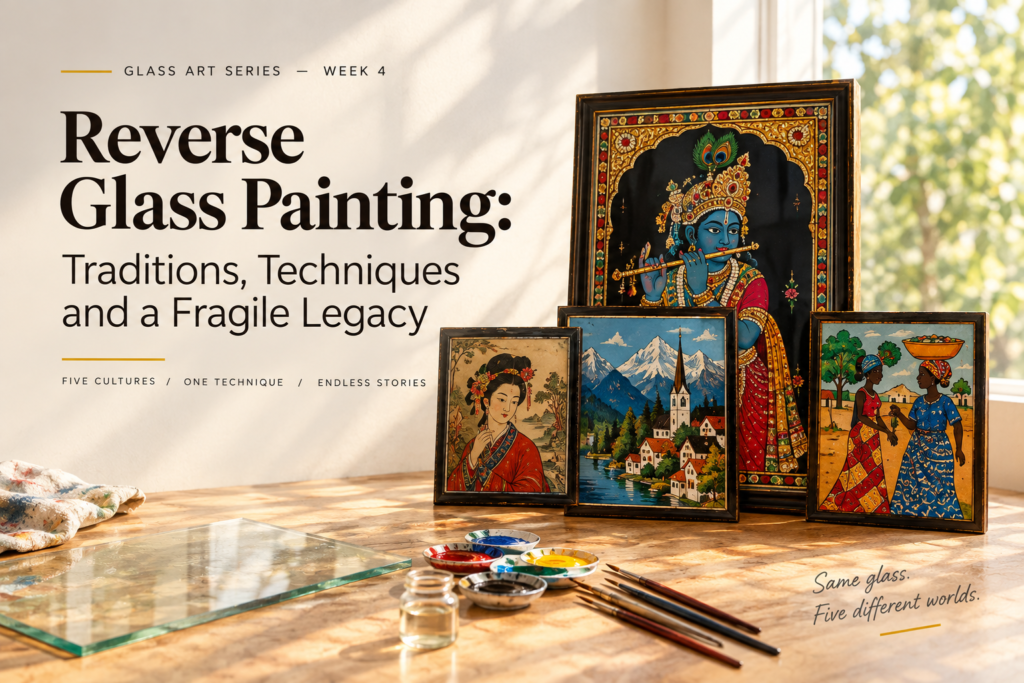
Every glass art form we’ve covered in this series involves assembling glass — cutting, joining, choosing sheets. This one is different. A single flat pane, never cut, and the artistry is entirely in how the paint goes on. Backwards.
The basic idea
Ordinary painting builds background to foreground. Reverse glass painting flips that completely — the details the viewer sees closest to them go on first, directly onto the glass, and the background goes on last. The viewer then looks from the other side, so the paint sits protected between the glass and the wall, permanently glossy.
There’s no fixing a background afterward. Painting over details covers them from the front, not behind them. Every layer has to be planned in reverse and executed correctly the first time. It’s less like painting, more like assembling a precise sandwich where you can’t see the result until the last layer goes in.
Five traditions, one constraint
→ China — reverse glass painting since at least the 18th century, producing portraits and landscapes that became a genuine luxury export to Europe.
→ India — particularly the Tanjore tradition, deities in bold colour and gold leaf for household worship, arriving via Chinese trade and European contact then becoming distinctly Indian.
→ Bavaria/Alps — Hinterglasmalerei, centred on villages like Oberammergau, largely religious folk subjects painted by farming families during winter months.
→ Romania — Transylvania and Maramureș, one of the most vividly still-practiced versions, bold and flat, internationally recognised as distinctly Romanian.
→ Senegal/West Africa — sous-verre, a completely independent and far more secular tradition depicting everyday life and political commentary in graphic, vivid compositions.
Same technical constraint, five entirely different cultural answers.
Why it’s genuinely at risk
Unlike stained glass, which has hobbyist communities and retail supply chains keeping it visible, most reverse glass painting relies on a shrinking number of practitioners who learned directly from family or a local master.
It doesn’t scale into a weekend workshop the way foiling does — the skill is almost entirely sequencing and planning, which takes years of mentorship. Religious and rural subject matter has less market pull with younger buyers in some regions. Tourism has flattened parts of the tradition into repetitive souvenir imagery. And it rarely gets the museum or gallery attention fine art painting does.
What actually helps preserve this
→ Credit the tradition by name — say Hinterglasmalerei, say sous-verre, say Tanjore glass painting, not just “glass art” → Seek out and share practitioners speaking about their own work, not explainers written by outsiders → Support cultural centres and cooperatives in originating regions over souvenir retailers → Treat the imagery as belonging to living communities, not a generic aesthetic to freely borrow
Week 4 of a weekly series on glass art. Next up: fused and kiln-formed glass, and why it’s grown faster than any other branch in the last two decades.