
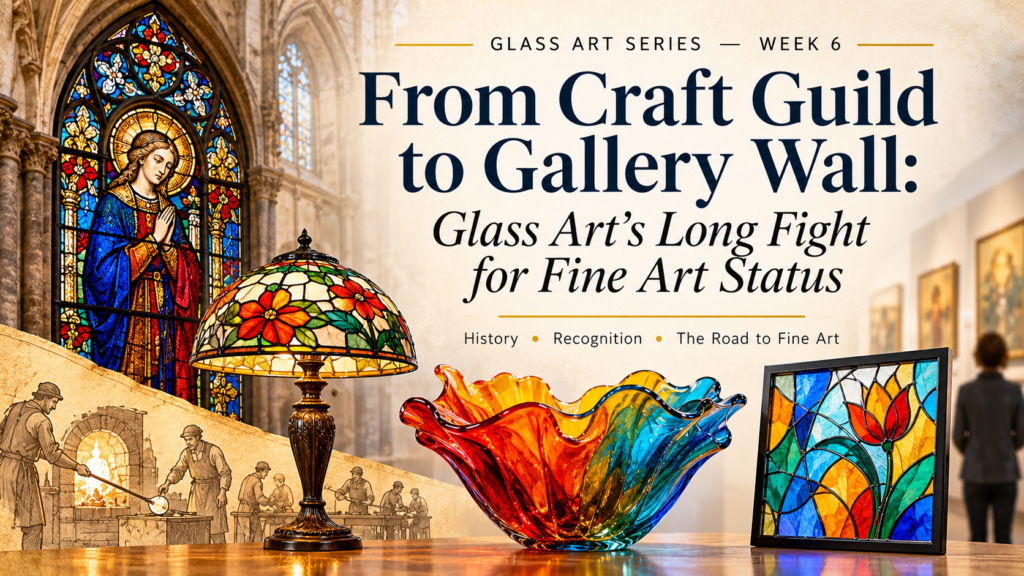
In Week 1, I mentioned that most people can name five famous painters before they can name a single glass artist. This week we look at why. The short version: for most of its history, glass wasn’t treated as an art medium at all. It was treated as a trade. The story of how that changed, and how incomplete the change still is, explains a lot about the awareness gap this series is trying to close.
The Medieval Workshop: Anonymous Masters
Some of the most extraordinary glass ever made was produced by people whose names we don’t know.
During the great age of Gothic cathedral building in Europe, stained glass windows were produced by teams of glaziers working in workshops, often tied to the construction project itself. A window was a collective product: a designer drew the cartoon, glassmakers supplied the colored sheets, cutters shaped the pieces, painters added fine detail in glass paint, and glaziers assembled and installed the finished panel. The credit went to the patron, the bishop, or the cathedral, not to the individuals.
This matters for the awareness question. The most visible glass art in history, the windows that millions of people still walk under, comes with almost no famous artist attached. Painting developed a cult of the named master earlier and more firmly. Glass largely did not.
Venice and the Guarded Trade Secret
Venetian glassmaking is the clearest example of glass as a protected industry rather than an artistic practice. Venice’s glassmakers were organized under guild regulation, and the industry was concentrated on the island of Murano, a move traditionally dated to the late 13th century and commonly explained as a fire-safety measure for a city built largely of wood. It also had the effect of keeping the craft’s secrets close to the authorities.
Murano glassmakers held a respected, even privileged, status, but within a system that restricted their movement and guarded technique as a commercial asset. Skill was valued. The idea of an individual glassmaker as an independent artist with a personal vision was not the framework.
The 19th Century: Revival and Reinvention
Stained glass declined in many places after the medieval period, then saw a major revival in the 19th century, linked to Gothic Revival architecture and the wider Arts and Crafts movement, which argued that handmade work deserved respect equal to fine art.
Then came Louis Comfort Tiffany, whom we met in Weeks 2 and 3. Tiffany was a rare figure: a painter by training who moved into glass and built a large studio around it. His opalescent glass techniques and his lamps brought glass into the homes and the aesthetic conversation of wealthy buyers, and put a personal name on the work in a way the medieval workshops never did. Even so, much of his output was produced by a team of skilled workers, and the debate over who deserves credit in that kind of studio continues to this day.
The Turning Point: The Studio Glass Movement
The modern idea of the individual glass artist is usually traced to 1962, at the Toledo Museum of Art in Ohio. Harvey Littleton, a ceramics professor, organized workshops there with the glass scientist and engineer Dominick Labino, who developed a glass formulation that melted at a low enough temperature to be worked in a small furnace.
That technical detail is the real story. Before this, glassblowing required industrial-scale furnaces that only factories could afford. Once a single artist could melt and work glass in a studio, glass could be made the way a painter paints or a potter throws: alone, experimentally, and as personal expression. Littleton went on to establish a glass program at the University of Wisconsin, and his students spread the idea across American universities.
This is what people mean by the Studio Glass Movement. It didn’t invent glass art, but it changed who could make it and why.
Dale Chihuly and the Visibility Paradox
Dale Chihuly studied under Littleton and became the most publicly recognized glass artist in the world, known for large-scale, colorful, organic installations. He also co-founded the Pilchuck Glass School in Washington State in 1971, which became a major training center for glass artists internationally.
His success is a genuine asset to the field: he put glass in front of audiences who would never have visited a stained glass studio. It also creates what I’d call the visibility paradox. When one name stands in for an entire medium, everything else, the folk traditions from Week 4, the foil and came workers, the kiln-formers, the working studio artists, becomes harder to see. Awareness that flows through a single celebrity is fragile and narrow.
Craft vs. Art: The Argument That Won’t Go Away
Even now, glass sits uncomfortably in the art world’s hierarchy. A few of the reasons:
- The craft label sticks. Because glass involves technical mastery of materials, galleries and critics have often filed it under craft or design rather than fine art, which affects pricing, critical coverage, and museum acquisition.
- Collaboration complicates authorship. Large glass pieces often involve teams, blowers, assistants, and fabricators. Who is the artist when the designer isn’t the one at the furnace? The art world, which prizes the single author, has trouble with the question.
- Function muddies categorization. A fused bowl can be a dish or a sculpture, and many collectors and institutions treat the useful object as lesser.
- Fragility and logistics limit exhibition. Glass is expensive to ship, insure, and install, which shapes what museums and galleries are willing to show.
None of these are reasons glass is lesser art. They’re structural reasons it has been treated as if it were.
What This Means for Working Glass Artists Today
A few practical takeaways for anyone making or selling glass work:
- Name your process and your influences. Specific language, such as “kiln-formed,” “reverse-painted,” or “copper-foil construction,” signals seriousness and helps buyers and curators place the work.
- Document your making. Because glass has historically credited the workshop over the maker, a visible record of your own hand in the work matters more than it might for a painter.
- Look beyond craft fairs. Craft venues are valuable, but also pursue juried art exhibitions, residencies, and glass-specific institutions, so the work is seen in art contexts as well.
- Write the artist statement. A clear statement about intent shifts how people read functional or technical work.
Sharing This Week’s Topic
History posts perform well when they center on a surprising human detail rather than a date list:
- “The artist was anonymous” is a strong opener. Millions of people have stood under windows made by people no one can name.
- The low-temperature glass story is a good example of a technical breakthrough changing an entire art form. It makes a satisfying short video or carousel.
- The craft-vs-art question invites discussion. Asking your audience where they draw the line reliably generates comments.
- Pair historical images with current studio footage to connect the lineage to the living practice.
Where This Is Headed
Next week we get practical again: how to set up a small home glass studio on a realistic budget, what to buy first, what to skip, and how to keep the space safe.
Next Sunday: Your First Glass Studio — Setting Up at Home Without Overspending