
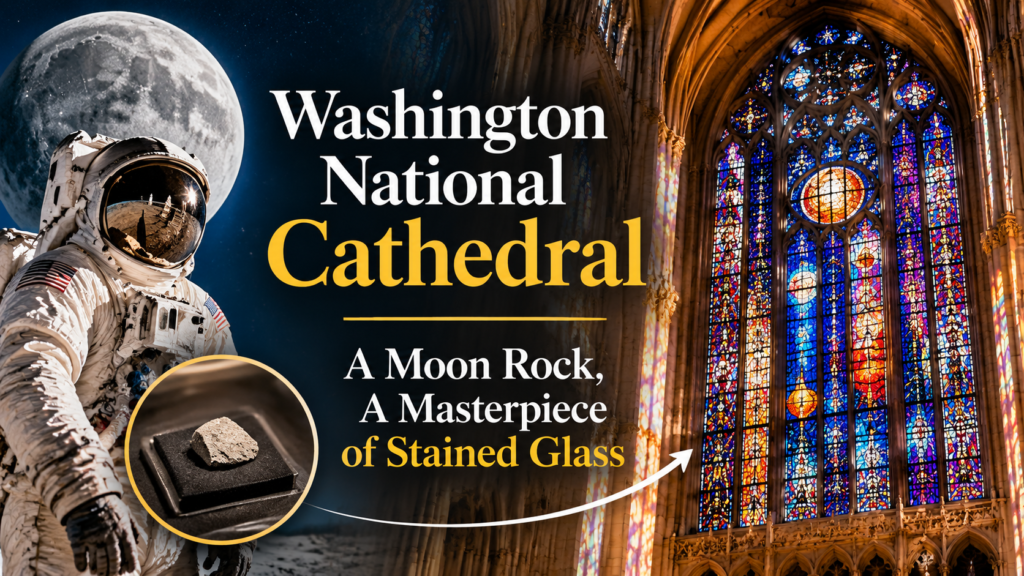
What do an Apollo 11 astronaut and a Gothic cathedral have in common? One remarkable window. Here is the story behind Washington National Cathedral and its stained glass.
Washington National Cathedral sits on a hill in the nation’s capital. Builders laid its first stone in 1907. They finished the last tower in 1990, after 83 years of work. As a result, the cathedral blends bold modern art with Gothic design. Visitors step into a tall nave and look up at walls of glowing color. The cathedral also holds one window that no other church can match. That window carries a real piece of the moon.
The Significance of the Stained Glass Windows
Most great cathedrals date back to the Middle Ages. This one grew up in the modern age. Therefore, its glass speaks about modern life. Artists here do not copy medieval styles. Instead, they use bright color and abstract shapes. In addition, the windows cover topics that medieval glaziers never imagined, such as space flight. Together, the more than 200 windows tell the story of humankind. The story starts with creation in the West Rose Window and moves east toward the future. For that reason, a walk through the nave feels like a walk through time. Many visitors say the glass is the first thing they notice. Sunlight pours through each pane, and colored light moves across the stone floor all day.
Three Windows That Define the Cathedral
1. The Space Window (South Side of the Nave)
Rodney Winfield, an artist from St. Louis, designed the Space Window. Its official name is the Scientists and Technicians Window. Winfield drew on photos from the Apollo 11 mission. As a result, blue, green, red, and orange circles float across the glass like planets. Near the top, a small white circle holds a sliver of moon rock. Astronauts Neil Armstrong, Buzz Aldrin, and Michael Collins gave the rock to the cathedral on July 21, 1974.
That date marked exactly five years since the first moon landing. The rock weighs just over seven grams, and scientists estimate its age at about 3.6 billion years. Because the rock is so fragile, workers sealed it in a capsule filled with nitrogen. However, fear of vandals delayed the installation until 1977. Until then, a black paper circle took its place. Today, visitors still search the glass for that tiny circle. Many stand in front of it for several minutes.
2. The West Rose Window (Main Entrance)
Rowan LeCompte designed the great West Rose Window. Cathedral leaders gave him the contract in 1970. The window shows the creation of light from the book of Genesis. However, it does not show a single person or animal. Instead, it uses abstract bursts of color built from more than 10,500 pieces of glass. Deep blues and reds seem to explode outward from the center. Meanwhile, the project fell behind schedule. By January 1976, only three months remained before the dedication, and some people doubted the design. Still, the window took its place in the nave that year. Today it greets every visitor at the main entrance.
3. The Nave Clerestory Windows (Upper Level)
LeCompte also designed the whole row of clerestory windows high above the nave. In all, he created more than 40 windows for the cathedral. His story with the building began early. He sketched his first window design in 1939, at age 14. After that, he spent his whole career at the cathedral. He saw stained glass as a living art form, not a copy of the past. For example, he tucked tiny images of missiles into one window as a quiet protest against military buildup. Because of choices like this, his windows feel personal and honest. Together, his windows give the nave a steady rhythm of color.
The Craftsmanship and Design
These windows still rely on traditional methods. First, LeCompte drew full-size reference drawings, called cartoons. Next, craftsman Dieter Goldkuhle built the glass to match them. The leaded design also proves strong. In 2011, an earthquake damaged parts of the cathedral. Even so, the Space Window protected its moon rock. Restorers have also used LeCompte’s cartoons to repair damaged glass. As a result, the new work matches the original. Careful planning like this keeps each window true to its artist. In the end, each pane of glass starts as a simple sketch. Then skilled hands turn it into light.
A Testament to Faith and Art
Washington National Cathedral proves that stained glass is still a living art. Medieval craftsmen told Bible stories in glass. In the same way, modern artists here tell the story of their own age. A moon landing and a rose of pure color now share one roof. Together, they show that faith and curiosity can sit side by side. So, when you visit, look up. You may find a piece of the sky looking back.
Which window surprised you most? Share your thoughts in the comments. Then follow along, because a new cathedral story arrives every Sunday.