
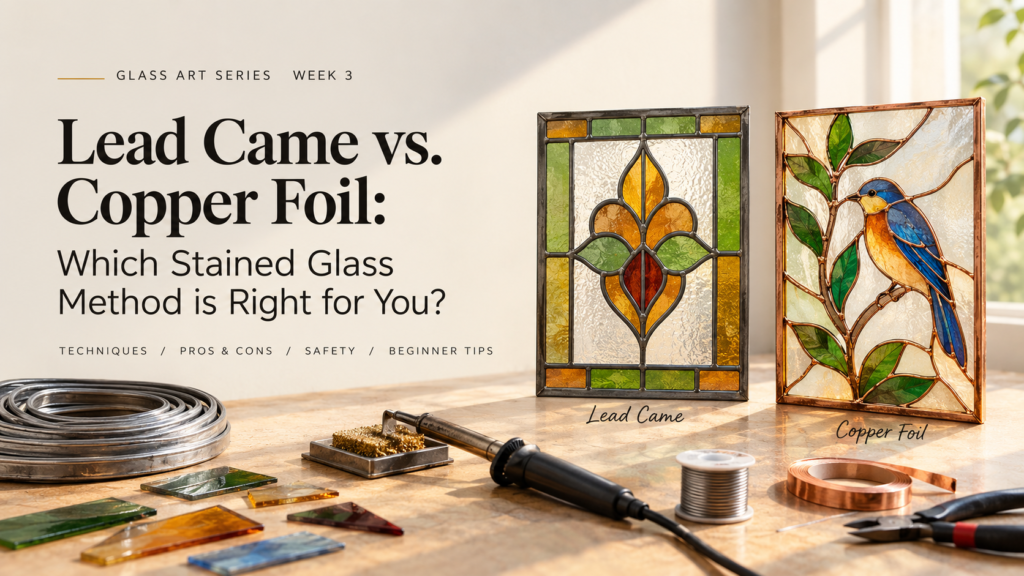
Ask ten glass artists this question and you’ll get a split room. Both answers are defensible — which is exactly why beginners get stuck here.
Here’s the thing most people don’t get told: these two methods aren’t really competing. They solve different problems.
The two approaches, briefly
Lead came is the older method — the one behind every cathedral window you’ve stood under. Extruded lead strips with channels running down each side. Glass slots in, joints get soldered, and the panel is cemented with putty to waterproof and stiffen it.
Copper foil (the Tiffany method) wraps each piece of glass in adhesive copper tape, then solders along every seam. The solder itself becomes the structure.
Where each one wins
Lead came → large flat panels, geometric designs, weather-exposed work, speed on big projects
Copper foil → intricate small pieces, tight curves, 3D work like lampshades and boxes, fine variable line weight
The honest beginner recommendation: start with copper foil
Not because it’s better. Because of four practical realities:
→ Lower startup cost — iron, tape, flux, solder and you’re going → It forgives imperfect cuts, and your first cuts will not be precise → It teaches proper soldering, since you’re beading every seam → Small projects finish fast, and early wins keep people in the craft
The exception: if your goal from day one is a large window or a church repair, start with came. Foiling at that scale is brutally slow and won’t give you the rigidity you need.
The safety part nobody should skip
Both methods involve lead. Came is solid lead; standard 60/40 solder is 40% lead. Exposure happens mostly through hand-to-mouth transfer, not mysterious fumes.
Standard practice: ventilate while soldering, wash hands before eating, no food on the bench, wet-clean rather than dry-sweep, keep the area away from where kids play. Lead-free solder is a reasonable option for foil work, especially for pieces going into a child’s room.
This isn’t exotic. It’s the same discipline as oil paint solvents or woodshop dust.
A note on sharing technique work
For glass artists building an audience: the process is more shareable than the product.
The four seconds where solder flows and pulls into a smooth bead outperforms a finished-piece photo almost every time. So does a bad cut getting rescued on the grinder. So do honest failure posts — a cracked panel three hours in gets more real engagement than a perfect result, because it makes the craft feel reachable.
Week 3 of a weekly series on glass art. Next up: understanding glass types — cathedral, opalescent, antique, and why red glass costs so much more.