
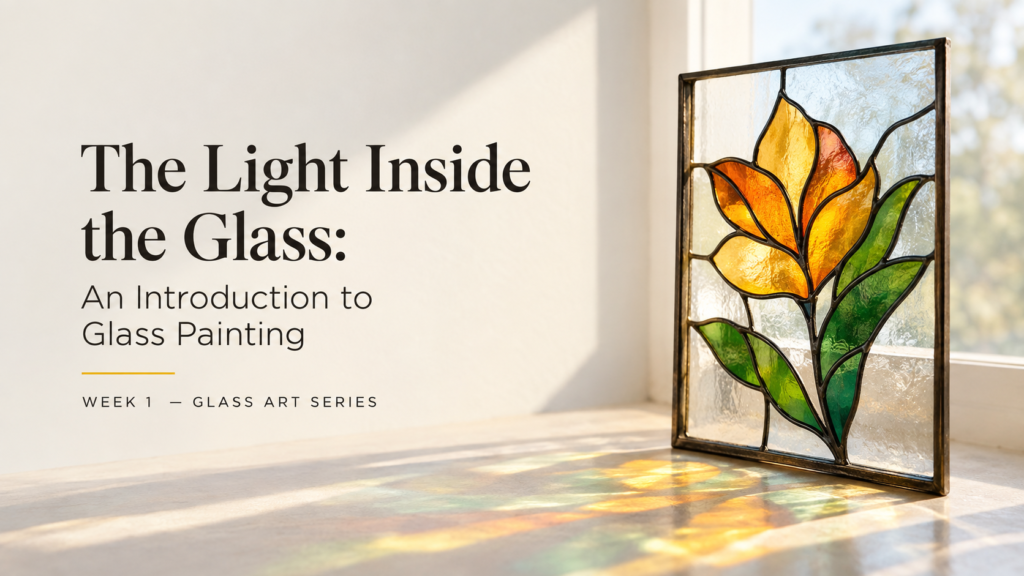
There’s a moment every glass painter knows: you hold a finished piece up to a window, and suddenly the colors aren’t just colors anymore — they’re alive, shifting with the sun, throwing pools of tinted light onto the floor. No other medium behaves quite like this. A canvas reflects light. Glass transmits it. That single difference is why glass painting has captivated artists for over a thousand years, from cathedral windows to the small hand-painted glass ornaments people sell at craft fairs today.
This week, let’s start at the beginning: what glass painting actually is, the main techniques people use, and why it deserves more attention as an art form.
What “Glass Painting” Actually Covers
The term gets used loosely, so it helps to separate the main branches:
- Stained glass — pieces of colored glass cut into shapes, joined with lead came or copper foil, forming an image from the glass itself rather than paint on top of it.
- Glass painting (reverse glass painting) — pigment applied directly onto glass, often painted in reverse order so the piece is viewed from the unpainted side. Popular in folk traditions across India, China, and Eastern Europe.
- Fused and kiln-formed glass — layers of glass and enamel powders melted together in a kiln to create texture and color blending that can’t be achieved with a brush alone.
- Vitrage and enamel painting — specialty glass paints and enamels fired onto glass at lower temperatures, common for decorative panels, tableware, and lamps.
Each of these has its own tools, its own learning curve, and its own community of practitioners — which is part of why this series will spend a full year moving through them one at a time.
How It’s Actually Done: The Basic Workflow
Most glass painting projects, regardless of style, follow a similar arc:
- Design and pattern — the image is drawn full-size on paper first. In stained glass, this pattern is literally cut apart to create templates for each piece of glass.
- Glass selection or preparation — choosing sheet glass by color and texture, or cleaning and priming a flat pane for painting.
- Application — cutting and fitting glass (stained glass), or applying pigment with brushes, pens, or airbrush (painted glass).
- Fixing the color — copper foiling and soldering for stained glass; kiln-firing or heat-setting for painted and enamel work.
- Finishing — patina, framing, hanging hardware, or sealing, depending on the piece’s final use.
The part that surprises beginners most is usually the waiting. Kiln firing can take twelve hours including cool-down. Enamel paints need curing time before a second layer goes on. Glass art rewards patience in a way that’s almost meditative.
Why Glass Art Deserves Wider Awareness
Compared to painting or ceramics, glass art has a much smaller public spotlight — most people can name five famous painters before they can name one glass artist beyond Dale Chihuly. A few reasons this matters:
- It’s a shrinking craft in some regions. Traditional reverse-glass painting styles, like Bavarian Hinterglasmalerei or Indian Tanjore glass work, have fewer practicing masters every decade as younger artists move toward digital mediums.
- It doesn’t photograph the way it lives. A photo of a stained glass panel loses the thing that makes it special — light passing through it changes throughout the day. This makes glass art genuinely under-documented online compared to other visual art.
- The barrier to trying it is lower than people think. You don’t need a home kiln to start. Basic reverse glass painting can begin with a pane of glass, enamel paint, and a few brushes.
Getting the Word Out: Simple Ways to Share Glass Work
If you’re a glass artist wondering how to get your work seen, a few approaches consistently work better than others:
- Shoot video, not just photos. Even a 10-second phone clip panning past a piece as light hits it communicates the medium far better than a still image.
- Local libraries, churches, and community centers. Many maintain stained glass and would welcome a short talk, demo, or small exhibit — an easy way to reach people who wouldn’t find you online.
- Craft and maker fairs paired with a live demo station. Watching someone foil and solder a piece in real time draws a crowd that a finished-product table alone won’t.
- Teach a two-hour beginner workshop. Nothing builds appreciation for a craft faster than making people try it themselves.
Where This Series Is Headed
Over the coming weeks, we’ll go deeper into specific techniques and traditions — copper foil vs. lead came construction, the chemistry behind glass color, reverse glass folk art traditions from around the world, kiln-firing schedules, and profiles of working glass artists. If there’s a specific technique or tradition you want covered sooner, let me know and I’ll prioritize it.
Next Sunday: The Copper Foil Method vs. Lead Came — Which Should You Learn First?