
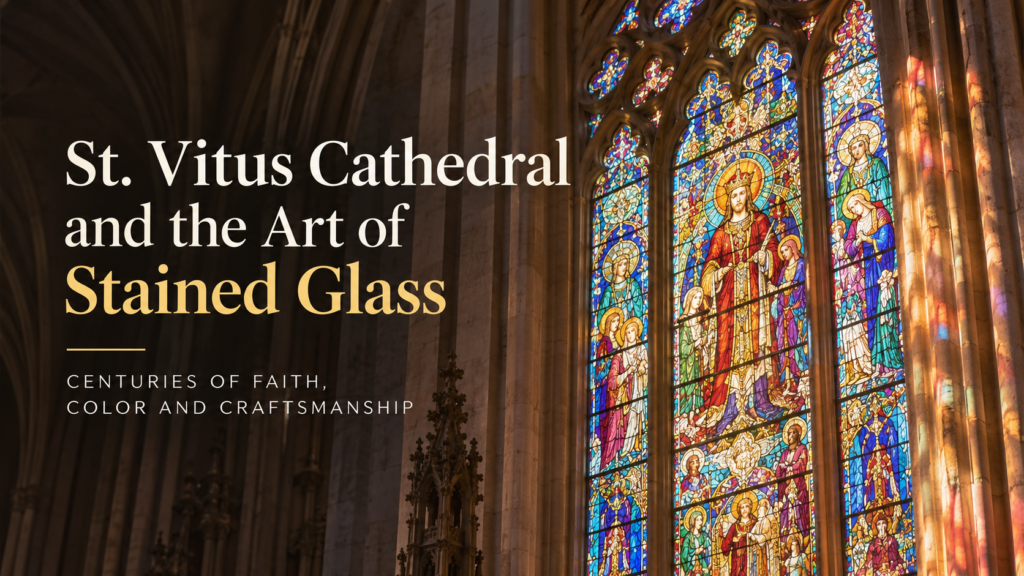
St. Vitus Cathedral sits at the heart of Prague Castle, and its history stretches back to the tenth century, when Prince Wenceslas built a small rotunda on the site. Builders started the Gothic cathedral seen today in 1344, but work dragged on for centuries. Crews only finished the west front in 1929, nearly 600 years later. That long timeline gave the cathedral something rare: stained glass windows spanning from high medieval tradition to twentieth-century Art Nouveau, all under one roof.
The Significance of the Stained Glass Windows
Each chapel at St. Vitus tells its own story in glass, often funded by a noble family or a bank eager to leave its mark on the nation’s most important church. The windows record Czech saints, national legends, and biblical scenes side by side. Because the cathedral took so long to build, its glass reads almost like a timeline. Walk from chapel to chapel, and you move from strict medieval symbolism to the flowing, decorative lines of early modern design.
Three Windows That Define the Cathedral
1. The Mucha Window (New Archbishop’s Chapel)
Czech painter Alphonse Mucha, famous for his flowing Art Nouveau posters, designed this window in 1931. He placed young St. Wenceslas at the center, raised by his Christian grandmother, St. Ludmila. Around them, he wove in the missionary saints Cyril and Methodius, who brought Christianity and a written alphabet to the Slavic people. Mucha even worked in a portrait of the goddess Slavia, honoring Slavia Bank, which funded the window. Unlike the cathedral’s older glass, Mucha’s panel uses soft washes of blue and gold rather than hard-edged medieval outlines, and the effect feels closer to a painting than a traditional stained glass scene.
2. The Creation Rose Window (West Façade)
This enormous rose window dominates the cathedral’s main entrance and depicts the biblical story of Creation. Radiating panels show the world taking shape piece by piece, from light and darkness to the first plants and animals. Because the window sits above the west door, morning crowds walk directly beneath it as they enter, and afternoon light sends colored patterns sweeping across the nave floor. Its scale alone makes it one of the largest and most photographed windows in the cathedral.
3. The Schwarzenberg Chapel Window
Artist Karel Svolinský designed this window in 1929 for the noble Schwarzenberg family. It tells two linked stories about Abraham: God asking him to sacrifice his son Isaac, and Hagar being rescued in the wilderness with her son Ishmael. Both scenes center on sacrifice and a parent’s love for a child. At the base of the window, the Schwarzenberg family itself kneels in prayer, thanking God for their own children, a detail that turns a biblical scene into a personal family memorial.
The Craftsmanship and Design
Because construction spanned nearly six centuries, no single style defines the glass at St. Vitus. Medieval chapels rely on bold lead outlines and saturated primary colors, built to be read from a distance. The twentieth-century windows, including Mucha’s, favor subtler shading and painterly detail, closer to fine art than traditional church glass. Wealthy families and institutions funded many of the chapels individually, which explains why each one feels like a self-contained work of art rather than part of one unified scheme. That patchwork history is part of what makes the cathedral so rewarding to study chapel by chapel.
A Testament to Faith and Art
St. Vitus Cathedral has crowned Bohemian kings, held royal coronations, and stored the Czech crown jewels for centuries. Its stained glass carries that same national weight. From medieval saints to Mucha’s tribute to Slavic history, the windows do more than decorate the building. They record how generations of Czechs saw their own faith and identity, panel by panel, chapel by chapel, across 600 years of continuous work.