
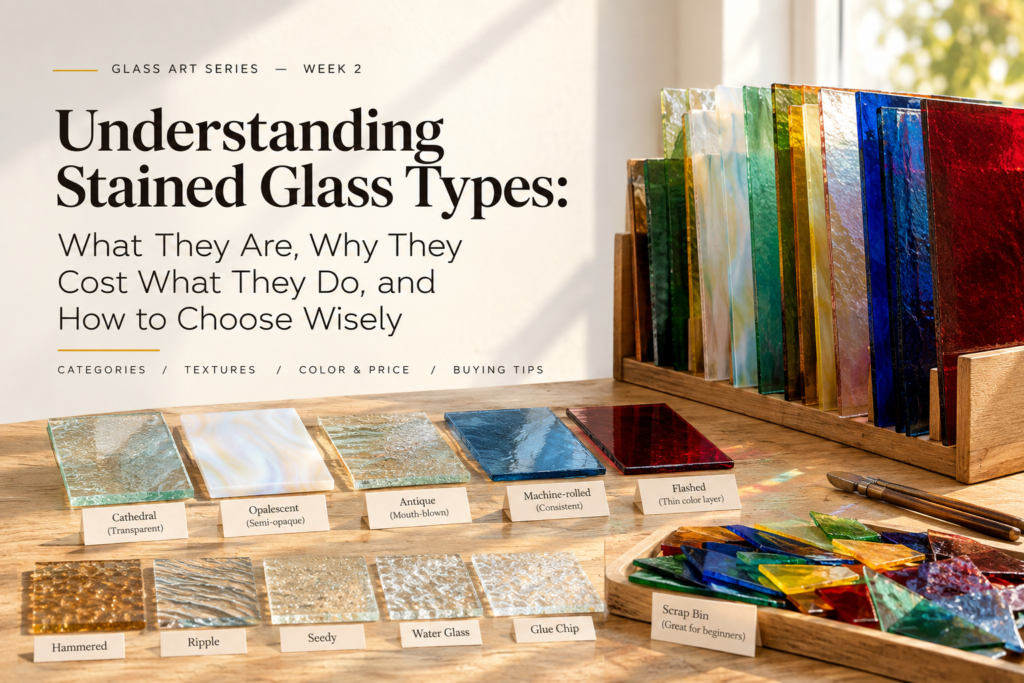
Walk into a stained glass supplier for the first time and the wall of sheet glass is genuinely overwhelming. Hundreds of sheets, prices ranging from a few dollars to well over a hundred for the same square footage, and labels using words that don’t mean what you’d assume. “Antique” glass isn’t old. “Cathedral” glass has nothing to do with cathedrals. And that one sheet of deep red costs four times what the blue next to it does.
This week: what the categories actually mean, why the prices vary so wildly, and how to choose glass without wasting money on your first few projects.
The Main Categories
Cathedral glass is transparent colored glass. Light passes through it and you can see shapes through it, the way you can through a tinted window. Despite the name, it’s the standard workhorse category — most machine-rolled colored sheet glass falls here. If a beginner kit includes glass, it’s almost certainly cathedral.
Opalescent glass is the milky, semi-opaque stuff — light comes through it and glows, but you can’t see objects through it. It ranges from faintly cloudy to nearly solid. This is largely an American innovation: both Louis Comfort Tiffany and John La Farge were working on and patenting opalescent techniques around 1880, and it’s the reason Tiffany lamps look the way they do. Opalescent glass is what makes a piece read well in reflected light, not just transmitted light — which matters a lot for lampshades and for panels hung against a wall rather than a window.
Antique glass refers to the method, not the age. It’s mouth-blown, traditionally as a cylinder that’s then cut, flattened, and annealed. The process leaves subtle striations, slight thickness variations, and small trapped bubbles called seeds. These irregularities scatter light unevenly, which is exactly why antique glass looks alive in a way machine-rolled glass doesn’t. It’s also the most expensive category by a wide margin, because a person blew it.
Machine-rolled glass is molten glass passed between rollers. Consistent thickness, consistent color, far cheaper, and available in every texture imaginable. Nothing wrong with it — most contemporary work uses it.
Flashed glass is a thin layer of intense color fused onto a clear or lightly-tinted base. The reason this exists is practical, and it connects directly to the red question below.
Textures, Briefly
Beyond color, sheets come in surface treatments: hammered, granite, ripple, seedy, water glass, glue chip (a frosted fern-like pattern created by animal hide glue contracting on the surface as it dries and tearing the glass face off with it). Texture changes how light scatters and, importantly, how much privacy a panel gives. A bathroom window wants heavy texture. A detailed pictorial panel usually doesn’t.
One practical note: always cut textured glass on the smooth side. Your cutter needs a consistent surface to score.
Why Red Costs So Much
Glass gets its color from metal oxides added to the melt. Most are cheap:
- Cobalt → blue
- Iron and chromium → greens
- Manganese → purple
- Sulfur and carbon → ambers and browns
- Uranium → the yellow-green “vaseline” glass that fluoresces under UV
Red is the problem child. The historical deep ruby red is produced with gold chloride — literally dissolved gold in the batch. Copper can also produce a ruby, and modern reds often use selenium and cadmium compounds, which are cheaper than gold but still significantly more expensive than cobalt, and increasingly regulated for toxicity.
There’s a second issue beyond raw cost: red glass at full body thickness is extraordinarily dense. A sheet thick enough to handle normally would be nearly black. This is why so much red glass — and pinks, and some deep blues — is sold flashed: a thin skin of the expensive color on a clear base, giving you a workable, luminous red at a fraction of the gold content.
Flashed glass has a bonus property artists exploit deliberately. Because the color layer is thin and on one side only, you can etch or sandblast through it to reveal the clear base underneath — producing fine detail, lettering, or shading within a single piece of glass with no lead line at all. Medieval glaziers used this technique extensively.
What This Means When You’re Buying
A few things that save beginners money:
- Don’t buy expensive glass for practice cuts. Clear window glass or the cheapest cathedral scrap is fine for learning to score and break. You will break a lot of it.
- Opalescent is harder to cut than cathedral. Score lines are difficult to see against the milky surface, and denser opalescents can run unpredictably. Start on cathedral.
- Watch for directionality. Streaky, wispy, and heavily textured sheets have a visual “grain.” Lay your pattern pieces out considering which way that grain runs before you cut — this is the difference between a piece that looks composed and one that looks accidental.
- Buy scrap bins. Most suppliers sell offcuts by weight. For small projects and suncatchers, this is by far the cheapest way to build a varied palette.
- If you ever move into fusing, COE matters. Coefficient of expansion — commonly 90 or 96 — describes how much the glass expands when heated. Mixing incompatible COEs in a kiln produces cracked work. It’s irrelevant for leaded and foiled work, but critical the moment a kiln enters the picture.
A Note on Where Glass Comes From
Worth knowing as context: the art glass manufacturing world has contracted considerably. Several long-running American manufacturers shut down or changed hands in the 2010s, and mouth-blown antique glass is now produced by a small number of European houses. Availability of specific colors and textures genuinely fluctuates, and artists who work in series often buy extra of a sheet they love, because it may not be there next year.
This is a quiet part of the “raising awareness” problem for glass art — the supply chain behind it is fragile in ways most people never see.
Sharing This Week’s Topic
Glass types are unusually good material for building an audience, because the visuals do the work for you:
- Backlight comparison shots. The same three sheets photographed against a window and then against a wall. The difference between cathedral and opalescent becomes obvious to a complete non-artist in one image.
- The UV reveal. Uranium glass glowing under a blacklight is a guaranteed attention-getter and an easy entry point into a conversation about glass chemistry.
- Show the scrap bin. People love seeing raw material. A tray of sorted offcuts by color is quietly one of the most satisfying images in the craft.
- Explain the red. “This piece of glass contains actual gold” is a fact that stops scrolls, and it’s true.
If you’re doing any kind of outreach — a library talk, a school visit, a fair booth — bringing a small set of sample sheets people can hold up to the light does more than any finished piece. Handing someone a piece of glass and letting them turn it toward a window is the whole pitch.
Where This Is Headed
Next week we leave stained glass behind and look at a completely different tradition: reverse glass painting, where the image is painted backwards onto the glass itself. It’s a folk art form with deep roots in India, China, Bavaria, and Romania — and it’s the branch of glass art in the most danger of disappearing.