
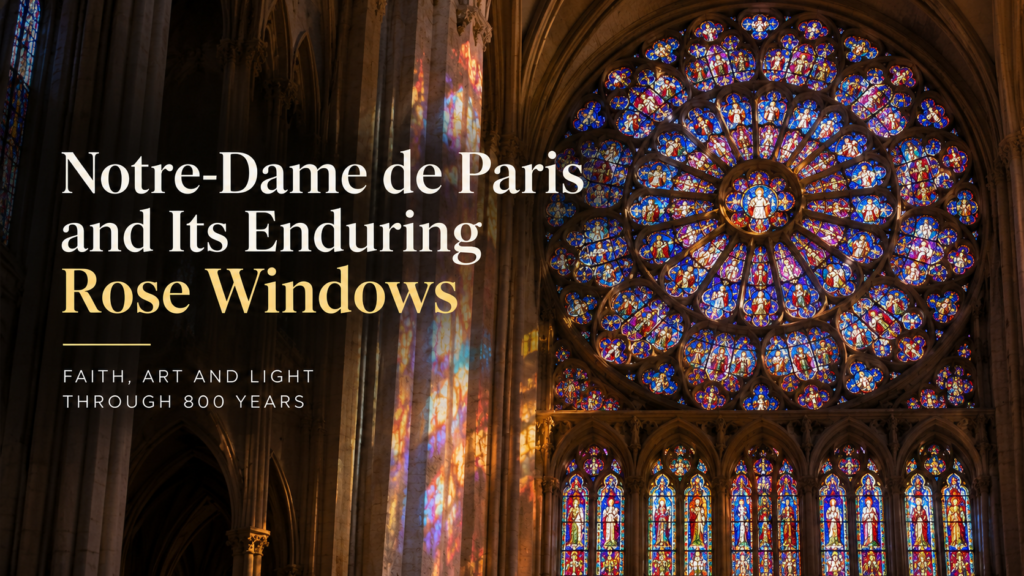
Builders began Notre-Dame de Paris in 1163 and worked on it for nearly two centuries. The cathedral has hosted royal coronations, survived the French Revolution, and watched over the city from its island in the Seine for over 800 years. On the night of April 15, 2019, fire tore through the roof and toppled the spire, and the world watched in real time as one of its most beloved landmarks seemed to be disappearing. But when the smoke cleared, firefighters found something remarkable. All three of the cathedral’s great rose windows had survived intact.
The Significance of the Stained Glass Windows
Notre-Dame’s rose windows rank among the most studied stained glass in the world. Medieval builders placed a rose window only at the center of a major facade, reserving the form for the most important sightlines in the building. Each rose at Notre-Dame builds toward a single vision: light dissolving stone, so the architecture itself seems to lift and disappear into color. Every pane also carries theology. Together, the three windows walk visitors through the Old Testament, the life of Mary, and the final judgment of Christ.
Three Windows That Define the Cathedral
1. The West Rose Window (Main Façade)
Craftsmen installed this window around 1225, making it the oldest and smallest of the three roses at 29 feet across. It sits directly above the main entrance, so nearly every visitor walks beneath it on the way in. Its glass shows scenes tied to the Old Testament and the signs of the zodiac, set in a thick stone frame that has held the panels steady for eight centuries. Because it faces west, the window catches the warm light of late afternoon, when the low sun sends gold and amber tones sweeping across the entrance hall.
2. The North Rose Window (North Transept)
This window, roughly 43 feet in diameter, places the Virgin Mary at its center, surrounded by kings and prophets from the Old Testament. Deep blues dominate the glass, a color medieval craftsmen prized so highly that Notre-Dame’s blue remains difficult to reproduce even with modern techniques. Because the north transept receives only indirect light, the window glows with a cool, steady intensity rather than the shifting brightness seen on the sunnier sides of the cathedral.
3. The South Rose Window (South Transept)
King Louis IX, later canonized as Saint Louis, donated this window around 1260, and it remains the largest of the three at nearly 43 feet wide. Christ sits enthroned at the center in glory, ringed by apostles, martyrs, and angels. Warm reds and golds fill the panels, colors chosen to reflect the direct southern sunlight that floods this side of the cathedral each afternoon. Restorers have repaired and adjusted the window several times over the centuries, but its central image of Christ in majesty has remained unchanged since the thirteenth century.
The Craftsmanship and Design
Medieval glaziers built each rose window from thousands of individual pieces of colored glass, held together by a web of lead strips called cames. Stone tracery radiates outward from the center like spokes, both supporting the glass and dividing the composition into readable scenes. Notre-Dame’s flying buttresses made this scale possible in the first place, since they carried the roof’s weight on external stone arches and freed the walls to hold glass instead of stone. When the 2019 fire sent burning debris crashing through the roof, engineers credit the windows’ sturdy lead and stone framework, along with sheer luck, for keeping the glass from shattering.
A Testament to Faith and Art
Notre-Dame reopened to the public in December 2024, five years after the fire, with its three rose windows cleaned and restored to their original brilliance. They had already survived revolution, war, and centuries of Parisian weather before the fire tested them one more time. Visitors who stand beneath them today are looking at nearly the same glass that medieval Parisians once did, colored light still doing exactly what its makers intended: turning stone into something that feels like it’s breathing.